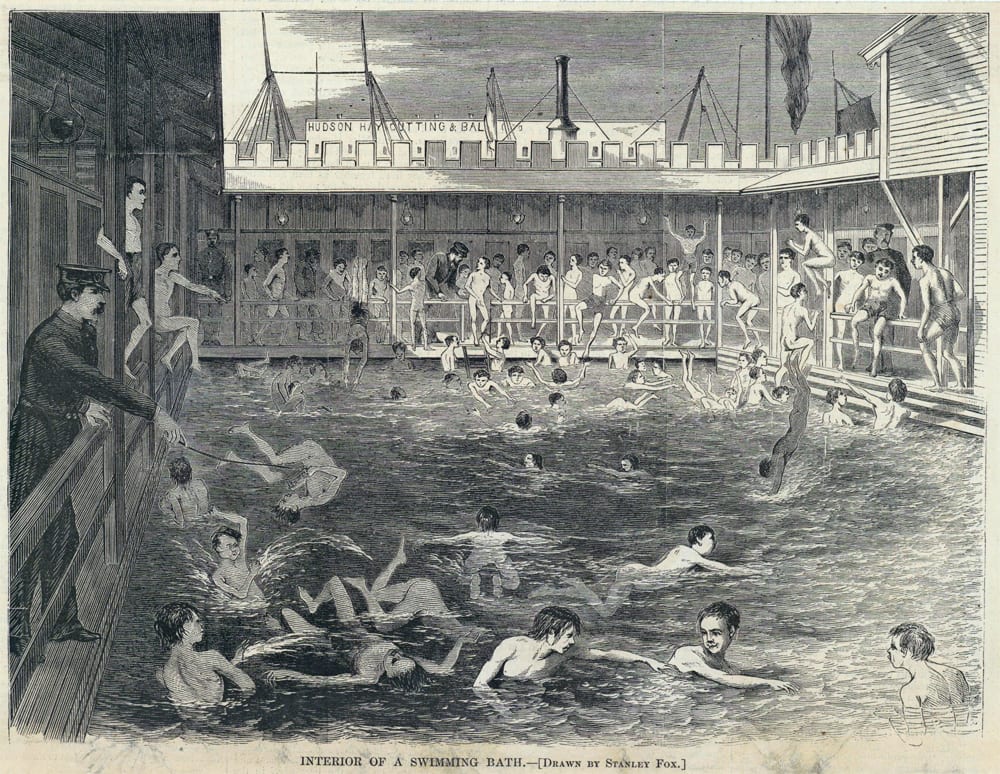
It is easy to forget how recently a bath became a private thing. In the New Haven of the 1880s a tenement flat had no tub, no hot water and often no water at all above the ground floor. Washing meant a basin, a kettle and a good deal of carrying — or it meant the river.
The bathing city
Through the summer the Mill River filled with people. Boys swam off the banks and the bridge abutments; families came down in the evening when the factories had stopped. This was ordinary in every American industrial city, and so was the fact that the water they were swimming in carried the discharge of every works upstream.
It was also, by the standards of the time, a public order problem. Boys swimming in a city river were visible from the street, and the argument about what to do with them ran alongside the argument about hygiene.
Why cities started building baths
From the 1880s a new argument spread through American cities: that cleanliness was not a moral failing of the poor but a service a city owed its residents, and that a city which gave people nowhere to wash had no standing to blame them for the diseases that followed.
It was a public health argument, and it was also a housing argument. The tenement was the problem; the bath house was the patch. New York, Boston, Chicago and Philadelphia all built free public baths on this reasoning, and the movement produced a recognisable building type: plain, functional, separated by sex, run to a timetable, and free.
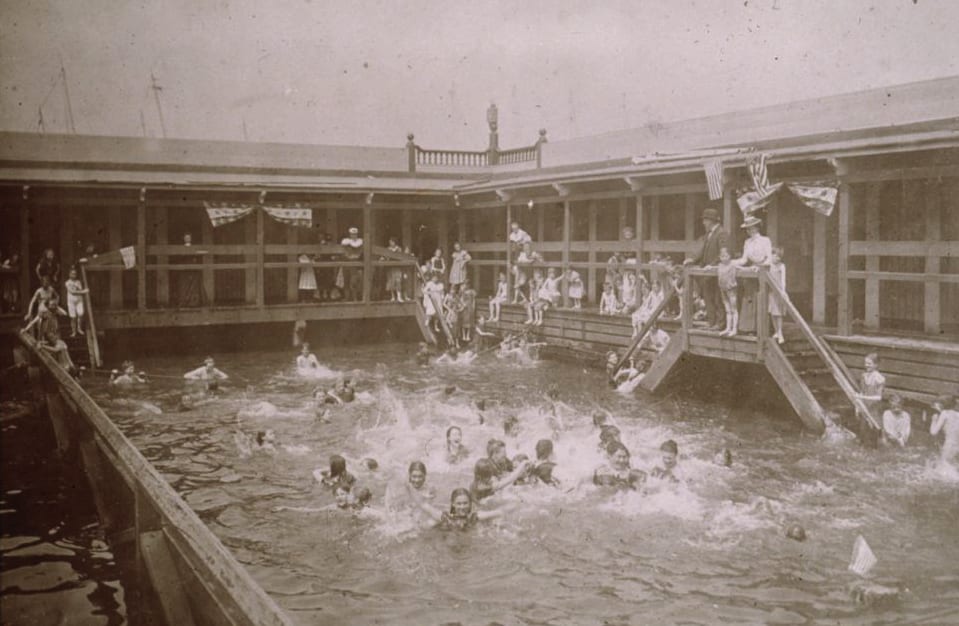
There were two kinds. The river bath was a floating or bankside structure — changing rooms, a walkway, an enclosure in the water, an attendant — cheap to build and dependent on the river being clean enough to swim in. The indoor bath came later, with piped water and showers, and was what eventually replaced it.
New Haven's
New Haven had the same debate, and it ran through the city council. The Morning Journal and Courier reported it, and those reports survive.
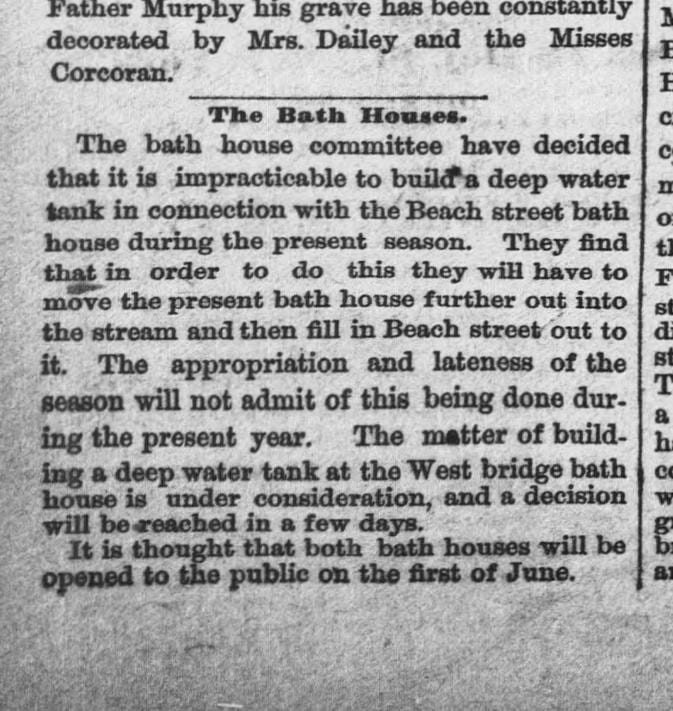
On 25 May 1880, under the heading "The Bath Houses," the paper recorded that the bath house committee had decided a deep water tank at the Beach Street bath house was impracticable that season: to build one they would have to "move the present bath house further out into the stream and then fill in Beach street out to it," and neither the appropriation nor the lateness of the season allowed it. A deep water tank at the West bridge bath house was still under consideration. The report ends: "It is thought that both bath houses will be opened to the public on the first of June."
So by 1880 New Haven had two municipal bath houses, a standing committee managing them, an annual appropriation, and an opening day.
The Mill River bath
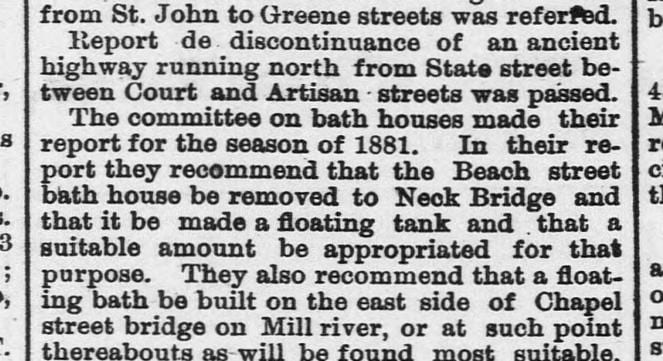
The following autumn the committee reported on the season of 1881. It recommended that the Beach Street bath house be removed to Neck Bridge — the old crossing at State Street — and made a floating tank. And it recommended "that a floating bath be built on the east side of Chapel street bridge on Mill river, or at such point thereabouts as will be found most suitable."
That is the Mill River bath house, in the city's own words: a floating bath, on this river, proposed in the autumn of 1881.
There were more than two. The council record turns up bath houses and bath house proposals at Beach Street, at the West bridge on the West River, at the foot of English Street in Fair Haven — remonstrated against by the neighbours and referred back to committee for three years running — at the Cedars, and by 1892 at the foot of Blatchley Avenue and the south end of Hamilton Street. By April 1889 the council was handling petitions for a "keeper of bath house on Mill river" and a keeper "on Beach street" as two separate posts.
The job
Here is the part nobody expects.
The keeper of a bath house was not hired by a foreman. He was elected, by the Court of Common Council, by ballot, with tellers appointed to count.
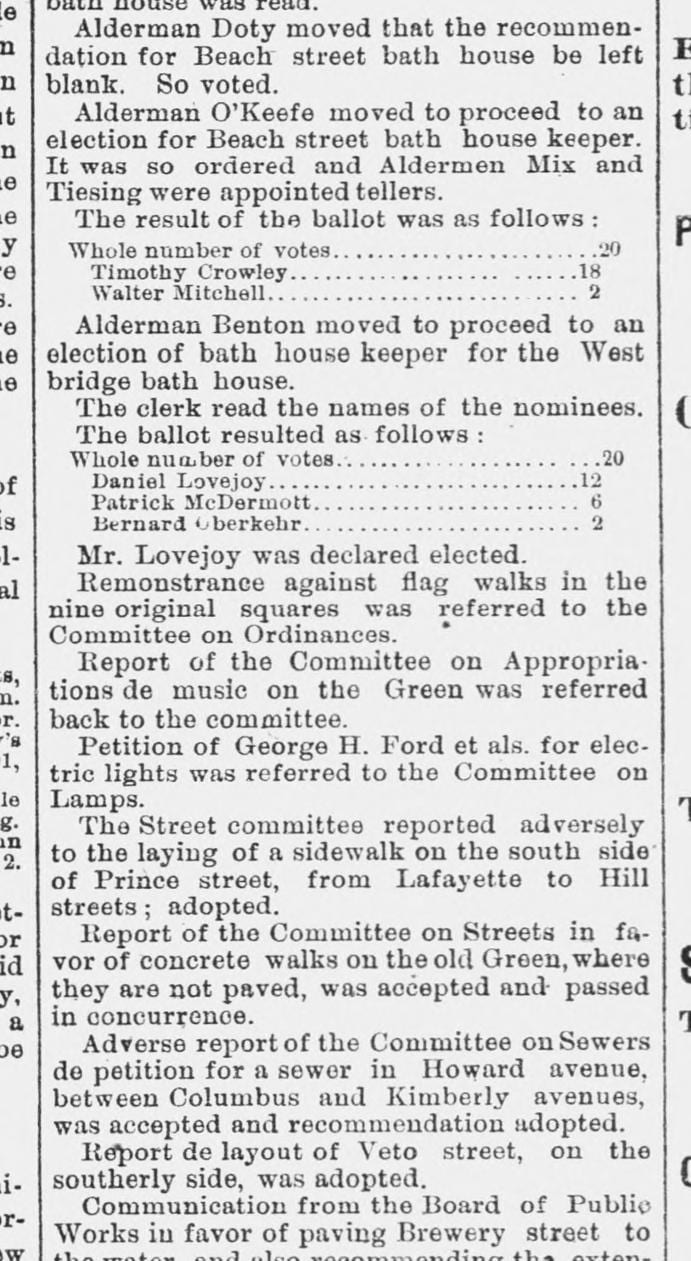
On 2 May 1882 Alderman O'Keefe moved to proceed to an election for Beach Street bath house keeper. Aldermen Mix and Tiesing were appointed tellers. Whole number of votes, 20: Timothy Crowley 18, Walter Mitchell 2. Alderman Benton then moved to elect a keeper for the West bridge: Daniel Lovejoy 12, Patrick McDermott 6, Bernard Oberkehr 2. That clipping is on this sign.
A year later, on 2 May 1883, the West bridge went to ten consecutive ballots, deadlocked four to four between Owen Kelly and Patrick McDermott, and had to be reported back to the council unresolved.
In May 1887 the thing turned nasty. Members of the committee received anonymous letters, described in the paper as "disgraceful in the extreme," intended to put the candidate Reynolds in an unpleasant light. The aldermen appointed him anyway; the council voted to recommit. The letter-writer was never discovered.
The pay was $2.50 a day. In June 1881 the committee met to reconsider even that, because the whole appropriation was $500 and at that rate it would be exhausted before the hot season closed.
Petitions to be made keeper run through the minutes for a decade: Lovejoy, Crowley, Michael Keys, Stephen Blakeslee, Edward Ward, James Noonan, Bernard Oberker, William Cummings, James Tiernan, Peter Sweeney, L. F. Cone. It was patronage, and it was a job, and in a city of tenements a steady summer wage was worth writing a letter to an alderman for.
The keepers were the lifeguards
Which is the other half of it, and the reason the job mattered.
In May 1883 a boy playing in a lumber yard near the Grand Street bridge fell in and was found drowned by Timothy Crowley, the bath house keeper. In July 1886 another boy went into the Mill River — slipped, or was pushed by playmates — and Crowley recovered his body with grappling hooks half an hour later. A doctor worked over him for an hour with a battery. He did not come back.
In August 1882 two sons of Margaret English, a widow of Wallace Street, drowned in the Mill River near the Beach Street bath house. A neighbour looking out of a window on Mill River Street saw clothes on the bank and sent her daughter down to see whether anyone was in the water.
In March 1889 the paper described a "well known Mill river bath house keeper" who "has probably saved about fifteen lives during his services as bath house keeper."
Fifteen. For $2.50 a day, on a contested ballot.
What we still do not know
Whether the floating bath at Chapel Street was ever built. How long any of them lasted. And whether they were free — the reports read as though they were, and the keepers were paid from a city appropriation rather than out of takings, but in October 1892 the committee was still advertising a meeting at which "the matter of establishing free public bath houses will be considered," so something was changing.
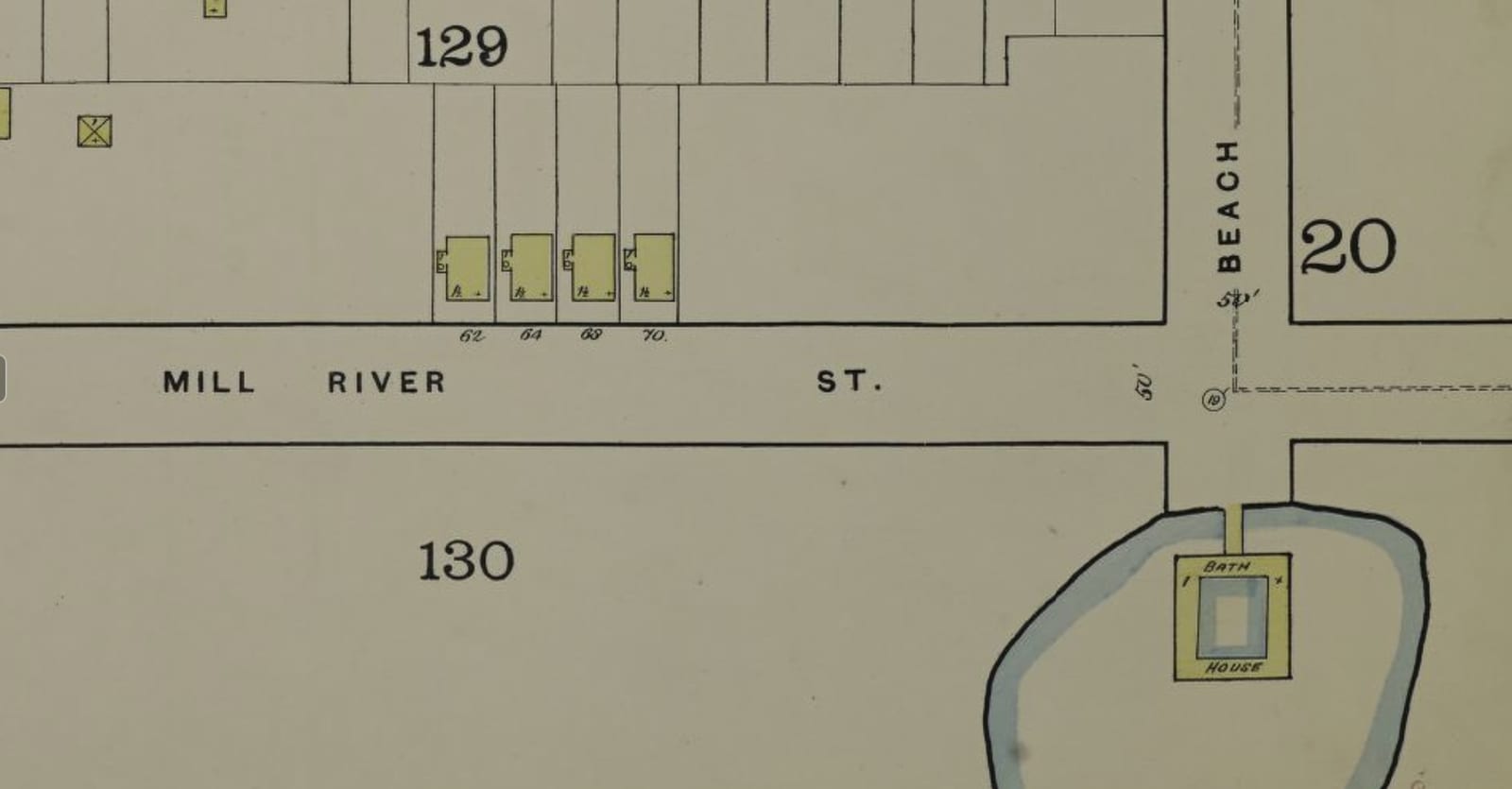
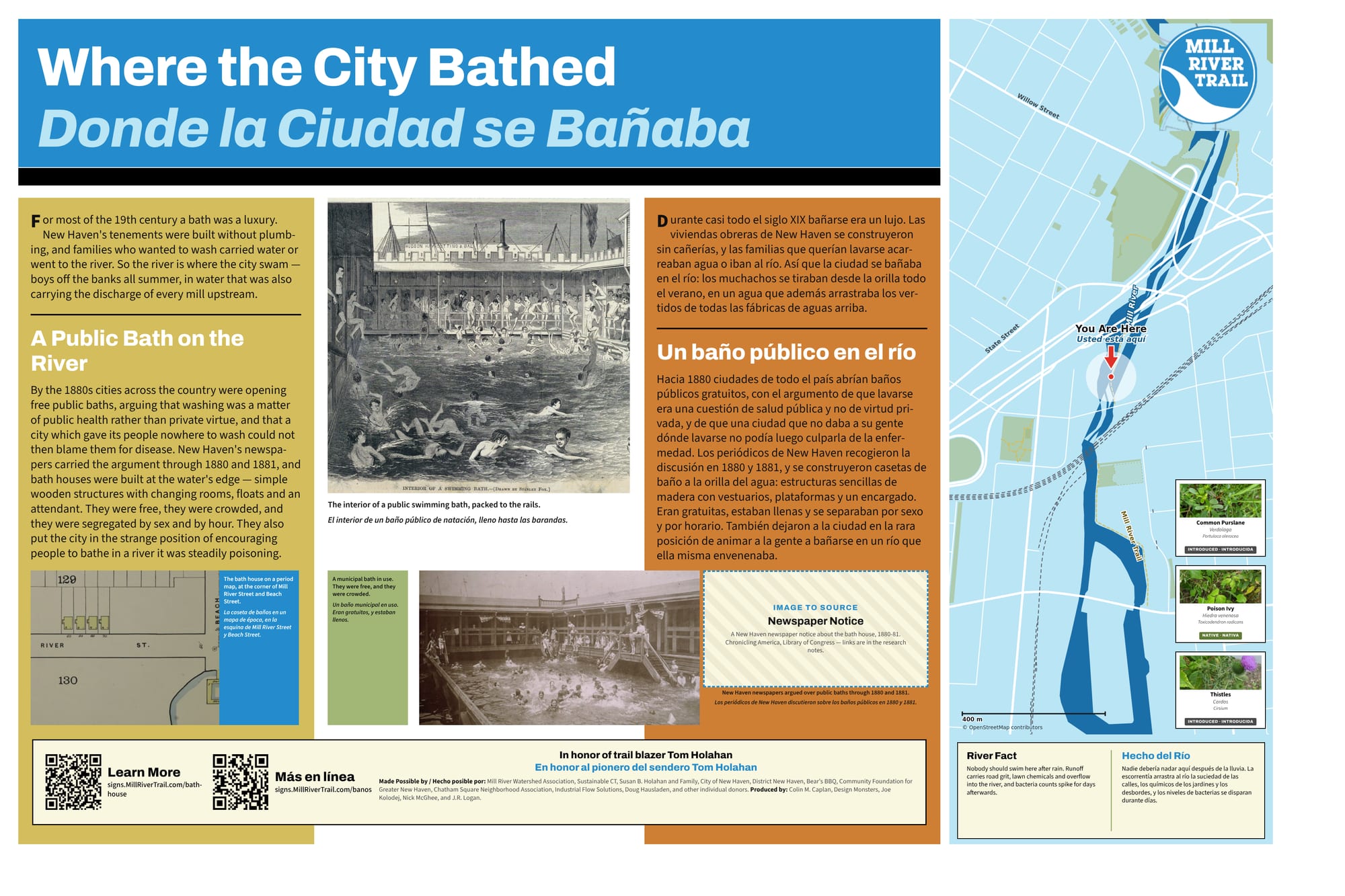
The 1888 city map shows a building at the corner of Mill River Street and Beach Street, which is the picture on this sign. Whether that is the bath house, or the site it was moved from, is not yet settled.
If you know something about these buildings, the project would like to hear it.
The contradiction
What the city could not do was make the water clean. The same decades that produced the bath house produced the factories whose outfalls ran into the river, and the argument about which mattered more went on for close to a century. Public baths eventually moved indoors and away from the river, plumbing reached the tenements, and by 1970 the Mill River tested at four times the legal limit for swimming.
The river was legally allowed to be dirty
This is the part people find hardest to believe, and it is true.
For most of the twentieth century American water law did not set one standard for all rivers. It classified them by the use they were meant to serve, and then applied the standard for that class. A river assigned a high class had to be clean enough to swim in and take shellfish from. A river assigned a low class did not. The dissolved oxygen minimum was a different number. The bacteria limit was a different number. Being dirty was not a violation if you were dirty in the class you had been given.
In April 1971 the federal government held a conference in New Haven on the pollution of Long Island Sound and its tributaries. The transcript lists Connecticut's classes and what each was for. Class SA meant all sea water uses, including shellfish for eating and bathing. Class SB meant bathing and shellfish after purification.
The Mill River was Class SC — "suitable fish, shellfish and wildlife habitat; suitable for recreational boating and industrial cooling."
Read that again. Boating and industrial cooling. Not bathing. On the river where the city had run a bath house.
Below SC there was one more step down, and the rule attached to it is revealing: Class D "will be assigned only where a higher water use Class cannot be attained after all appropriate waste treatment methods are utilized." A class for water that had been given up on.
How far this went is written into federal law by its absence. The rules that govern water quality standards today contain this sentence:
In no case shall a State adopt waste transport or waste assimilation as a designated use for any waters of the United States.
Nobody writes a rule like that unless it was being done.
What a witness said in 1971
The same New Haven conference heard this, about this river:
The New Haven Harbor is the terminal for three rivers: the West River, the Mill River and the Quinnipiac River. All of these streams are polluted in varying degrees and the Mill River is the classic example of our stream pollution problem. Its putrid grey green waters can only be appreciated by sight and smell. … The law is being compromised for jobs and our public waters have become their private sewer.
Ninety years after the bath house committee argued about where to put a floating tank, the river it argued over was being described to a federal hearing as somebody's private sewer.
It is not that any more. That took the Connecticut Clean Water Act of 1967, the federal Clean Water Act of 1972, and fifty years of work — and the switch from asking what a river was for to asking what came out of the pipe.
Water quality here has improved a great deal since the industry left. It still drops sharply after rain, when runoff from streets and lawns and overflow from ageing sewers reaches the river, and bacteria counts stay high for days afterwards. The bathing city is not quite as far in the past as it looks.
The sign at this spot
The full sign, in English and Spanish. Zoom in to read it.
Sources and further reading
Where a link goes to a scanned original — a newspaper page, a map, an engineering journal — it is the actual document, not a summary of it.
- Conference on pollution of Long Island Sound, New Haven, 13-14 April 1971 — transcript (US EPA)
- 40 CFR 131.10 — Designation of uses ("In no case shall a State adopt waste transport or waste assimilation as a designated use")
- Connecticut Water Quality Standards — CT DEEP
- The council elects bath house keepers — Morning Journal and Courier, 2 May 1882
- Ten ballots for the West bridge keeper — Morning Journal and Courier, 2 May 1883
- Anonymous letters against a candidate — Morning Journal and Courier, 10 May 1887
- "About fifteen lives" — Morning Journal and Courier, 13 March 1889
- The Beach Street bath house in the New Haven papers, May 1880 — Chronicling America
- The Beach Street bath house in the New Haven papers, October 1881 — Chronicling America
- 1888 map of the bath house area — Library of Congress
- Scenes from New York's public baths — Bowery Boys History
- Beach Street bath house in the New Haven city records, p. 304 — Google Books
- The birth and death of Manhattan's municipal baths
- Hygiene and swimming pools in New York City — Cities and Modernity
- Mill River bacteria TMDL — Connecticut DEEP
Research and credits
Historical research for the Mill River Trail signage was carried out by Colin M. Caplan of Magrisso Forte and John R. Logan, with contributions from Jason Bischoff-Wurstle of the New Haven Museum and walk notes by Steve Hamm. Images are credited individually. Locator maps are drawn from OpenStreetMap, © OpenStreetMap contributors, ODbL.
This page last changed 2026-10-12.