Criscuolo Park sits on a point of land where the Mill River runs into the Quinnipiac. Before it was a park it was called Grapevine Point, and before that it was marsh and oyster ground at the edge of Fair Haven.
The grapes are still here. A survey of the trail in 2024 recorded riverbank grape — Vitis riparia — growing along this water, twice. Whatever else has been done to this place in four hundred years, the plant it was named for is still climbing the banks.
The camps
New Haven raised troops fast in 1861 and had nowhere to put them. Temporary Civil War camps went up around the city — Camp Hamilton and Camp English among them — and in 1862 a camp was established here at Grapevine Point.
Three years of refusal
For the first two years of the war the Union would not take Black volunteers. Men who tried to enlist in Connecticut in 1861 and 1862 were turned away. The policy changed in 1863, after the Emancipation Proclamation and after the Army had run short of men.
Connecticut authorised the 29th Connecticut Volunteer Infantry (Colored) in 1863. It filled so quickly that a second regiment, the 30th, began forming behind it. They trained on this ground and mustered into federal service in March 1864.
What they did
The 29th went to Virginia and fought through the campaigns around Petersburg and Richmond. When Richmond fell in April 1865, the regiment was among the first Union troops into the city. It was later sent to Texas, and was mustered out in the autumn of 1865.
They came back to a state that had made them wait three years to serve, and to a country that would spend the following century failing to keep the bargain. The monument to the regiment stands in this park.
The oyster ground you are standing on
Before the camps, and long after them, this point was oyster country. The rivers here fed an industry that by the middle of the 19th century was second only to Baltimore's in volume, and that Fair Haven was built on.
Two things about it are worth knowing while you are at the water.
The beds were guarded, at night, by armed men in huts. Once the grounds stopped being a common and became private leaseholds, somebody had to sit out on the water and watch them. In September 1886 three boys aged twelve to seventeen stole a rowboat, pulled out to the watch house at Oyster Point, and took the watchman's double-barrelled shotgun, his revolver and his jack-knife. He was away, and got back just as they rowed off.
And the season opened at midnight. The public beds were shut all summer and the law came off at midnight on the first of November — and hundreds of people turned out to watch the start. Ernest Ingersoll wrote it down for the 1880 census: oilskins, lanterns on a hundred watch-dials, "a hush in the merriment along the shore, an instant's calm, and then the great bell struck a deep-toned peal. It was like an electric shock."
Pollution and overfishing collapsed the industry in the early 20th century; oystering on the Quinnipiac has been rebuilding since. (Sign 12, at Dragon Point, tells the oyster story in full.)
The park is named for Nicholas Criscuolo, and it is now one of the few places on the lower Mill River where you can stand at the water's edge on open ground and see what the whole system does — two rivers, one harbour, and the tide moving through both.
The sign at this spot
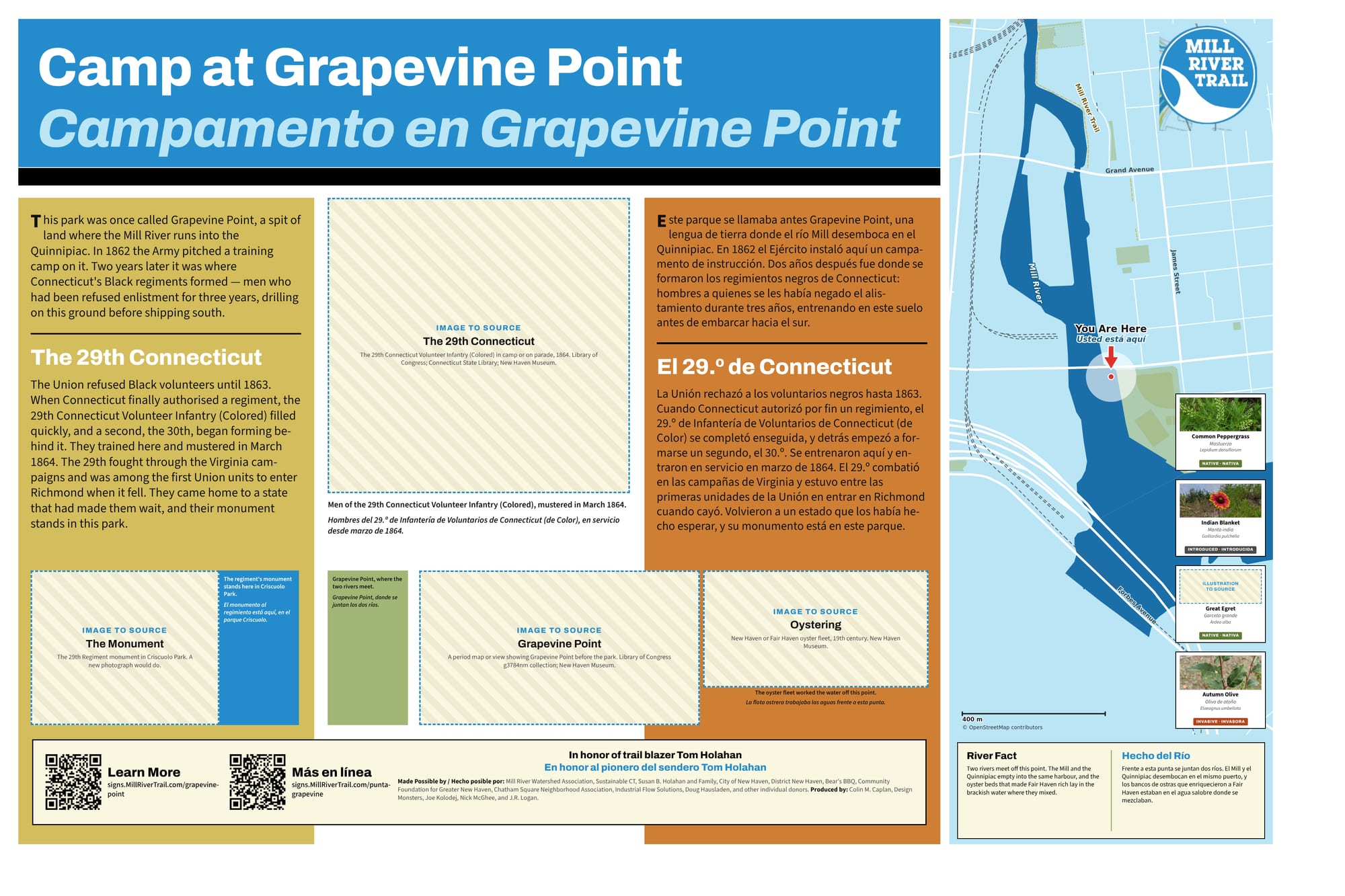
The full sign, in English and Spanish. Zoom in to read it.
This sign is still a draft. The hatched boxes are photographs that have not been sourced yet.
Sources and further reading
Where a link goes to a scanned original — a newspaper page, a map, an engineering journal — it is the actual document, not a summary of it.
- The Oyster Point watch house robbery — Morning Journal and Courier, 9 September 1886
- Ernest Ingersoll, The Oyster-Industry (Tenth Census, 1881) — the midnight race
- 29th Connecticut Infantry Regiment (Colored) — Wikipedia
- Connecticut Civil War camps, including Camp at Grape Vine Point — North American Forts
- Fair Haven, oystering and Clamtown — Yale-New Haven Teachers Institute
- What happened to the oysters — Yale-New Haven Teachers Institute
Research and credits
Historical research for the Mill River Trail signage was carried out by Colin M. Caplan of Magrisso Forte and John R. Logan, with contributions from Jason Bischoff-Wurstle of the New Haven Museum and walk notes by Steve Hamm. Images are credited individually. Locator maps are drawn from OpenStreetMap, © OpenStreetMap contributors, ODbL.
This page last changed 2026-10-12.