Most buildings get one story. This one got two, and both of them went around the world.
The box
The National Folding Box Company was assembled in New York in the early 1890s out of a group of smaller carton makers. In 1905 it picked New Haven as its production centre and bought this entire block on the Mill River — for the shipping, the rail spurs alongside, and the workforce living within walking distance in Fair Haven, Cedar Hill and Barnesville. The four-storey plant went up in 1914.
Those spurs are the part worth picturing. A private siding ran off the main line, across the yard and in through the wall of the building, so a boxcar could be filled where the boxes were made. The line it came off is the shoreline railway whose bridge stands downstream — abandoned now, and falling into the water. The largest folding box plant in the world was fed by a private track off a railway that no longer exists.
By 1927 it was the largest and most prestigious folding box company in the world.
This is easy to underrate, because a box is not a glamorous object. But the whole twentieth-century idea of a branded product — something you recognise on a shelf, sealed, printed, identical every time — depends on somebody making the container. National printed for Budweiser, for Hershey's, for General Electric, for the cigarette companies.
And for Peter Paul. National made the boxes for Mounds and Almond Joy — and had helped start Peter Paul in the first place, as an outside investment. A New Haven box company put money into a Connecticut candy company and then printed its wrappers.
Then the paperboard mills of the American South, sitting next to the timber, undercut New England on price. Federal Paper Board bought National in 1953 and kept the plant running until 1974, when it closed.
The jacket
In 1971 a coach at Hamden Hall named David Beckerman started a company and called it Starter — for being on the starting team rather than the bench. In 1976 he moved it into the empty box factory on James Street, and in that same year took a licence from Major League Baseball.
That licence is the hinge. Before it, a replica team jacket was not really a product you could buy; afterwards it was an industry. Starter added the NFL, the NBA, the NHL and the college programmes, and by the late 1980s the satin jacket with the S-and-star on the sleeve was one of the most recognisable objects in American popular culture — on the street, in videos, in every school corridor in the country.
It was designed, licensed and shipped from a building on the Mill River.
The end came fast. Starter went public in 1993. The 1994 Major League Baseball players' strike took the wind out of the market at exactly the wrong moment; the jackets were expensive to make; and there was ugly press about people being robbed for them, which is a real part of this story and not a footnote. The company declared bankruptcy in 1999.
Now
The building is still working. It houses ACES, the United Way of Greater New Haven and Workforce Alliance — education, social services and job training — and in May 2026 ACES bought it outright.
A daylight factory built for folding cardboard in 1914 is now full of people helping other people find work. That is a better ending than most New England mill buildings get.
Where you are
This stretch of the Mill River is Barnesville, and it has been the edge between the city and its industry for two centuries. The tide gate is just upstream. The bridge where two boys drowned in 1892, prompting a newspaper headline reading "Need of a Bath House," was a few hundred feet from here.
The sign at this spot
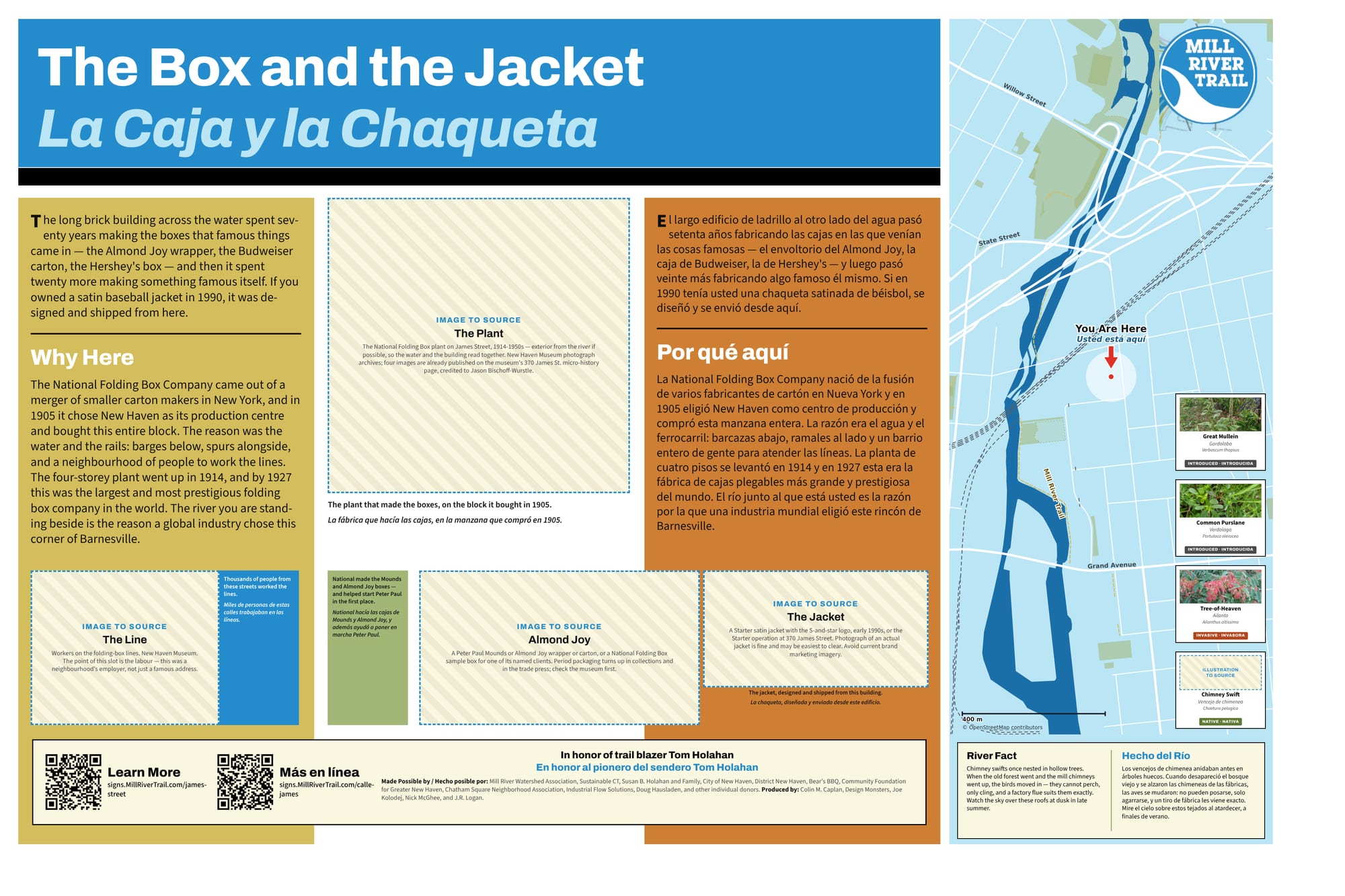
The full sign, in English and Spanish. Zoom in to read it.
This sign is still a draft. The hatched boxes are photographs that have not been sourced yet.
Sources and further reading
Where a link goes to a scanned original — a newspaper page, a map, an engineering journal — it is the actual document, not a summary of it.
- 370 James St. — Home of the National Box Company and Starter, Inc. (New Haven Museum)
- River St. — New Haven Museum micro-history
- ACES buys Fair Haven office building for $14.6M — New Haven Independent, May 2026
- River Street Historic District, New Haven
Research and credits
Historical research for the Mill River Trail signage was carried out by Colin M. Caplan of Magrisso Forte and John R. Logan, with contributions from Jason Bischoff-Wurstle of the New Haven Museum and walk notes by Steve Hamm. Images are credited individually. Locator maps are drawn from OpenStreetMap, © OpenStreetMap contributors, ODbL.
This page last changed 2026-10-12.