Stand on this bank and try to widen the river in your head. Before the filling, both sides were marsh and open water, and the far bank was a good way further off than it looks now. The solid ground over there, and much of the ground under you, is made land.
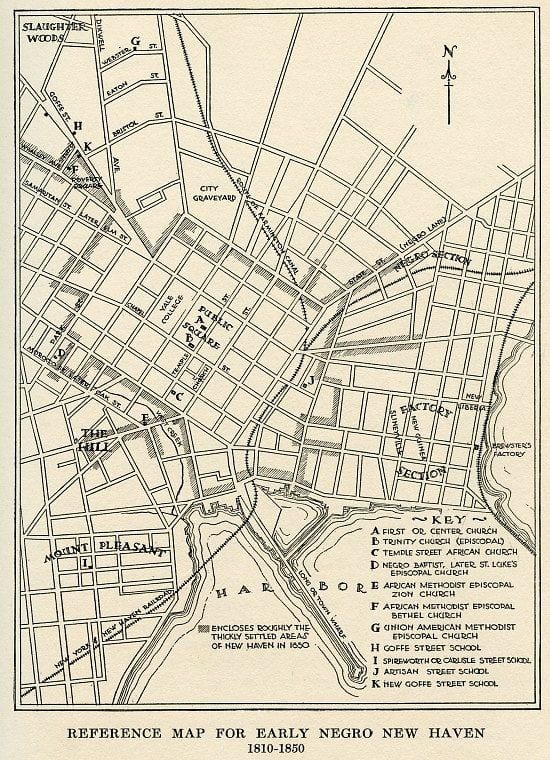
On the far side, in the corner of the old New Township nearest this river, was a neighbourhood its own residents named New Liberia.
The names of this ground
The area between Olive Street and the Mill River — taking in Chapel, Academy, East, Franklin, Greene and Grand — was New Township, added to New Haven in 1784. Inside it, people named their own smaller places. There was New Guinea, east of Wooster Square, where William Lanson held land before selling it. There was New Liberia, at the end of Greene Street, which he built. Next to it was Slineyville, the Irish district. North, at Grand Avenue and East Street running down to the water, was Barnesville, named for the innkeeper Eli Barnes.
Only Barnesville and Fair Haven made it onto maps that lasted. The others were named by the people who lived in them, and left the record when those people were pushed out of it.
Twenty-five tons at a time
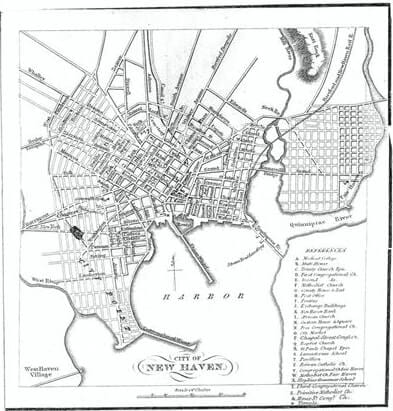
New Haven harbour is shallow. A loaded ship could not reach the town and had to anchor offshore and be unloaded by lighters — slow, expensive, and a permanent drag on the port. The wharf had to be pushed out to deep water, and the ordinary method of driving wooden piles would not hold in the soft harbour floor.
Two contractors had already tried and given up. Lanson took it on, he said, to "show what a black man was capable of doing."
His answer was stone. He owned a quarry in East Haven, on Blue Mountain, and had flat-bottomed scows built that could carry twenty-five-ton stones — loading them at a wharf he designed for the purpose and taking them across the harbour to the pier head. He described the work himself:
"The tide in this river rises about six feet, and it is considered very dangerous going under the bridge. A scow must go up on the flood tide and come down on the ebb tide, and it was always considered to want three men to manage a scow, and get one load, in the day time. But I have performed the same thing myself, many a time, alone, at the night tide … and got my load, the darkest night that had ever been."
Read that with the tide in mind. A loaded scow moves one direction per tide. He was riding the flood up and the ebb down, in the dark, alone, on a job that was reckoned to need three men and daylight.
A note on which river. Lanson says "this river" and does not name it, and this project used to assume he meant the Mill. He probably did not. The 2024 National Register nomination for Long Wharf Pier places his quarry in East Haven and has the stone crossing the harbour, which puts the dangerous bridge on the Quinnipiac side rather than here.
It is fair to say his scows and this river shared water. The Mill joins the Quinnipiac at Grapevine Point, a mile downstream of where you are standing, and both empty into the same harbour he worked across. But a boat that passes the mouth of a river has not worked its way up one, and we would rather say so than stretch a connection. His link to this water is not the stone. It is the land.
By 1812 Long Wharf reached 3,480 feet into the harbour: the longest wharf in the United States. He went on to build Steamboat Wharf, Basin Wharf and the Tomlinson Bridge; his son Isaiah also credited him with the East Haven bridge. In 1827 James Hillhouse hired him to build the Farmington Canal basin, and he used the same Blue Mountain stone and the same methods.
What he did on this river
On 2 March 1807, three or four years after arriving in New Haven, Lanson bought land on the west bank of the Mill River, on the far edge of what was then called the New Township and is now Wooster Square. It had belonged to Mary Wooster, and had been used for ploughing contests.
That purchase mattered twice over. It was the ground on which he later built New Guinea and then New Liberia — the Black neighbourhood across the water from where you are standing, with his boarding house in it, sheltering Black workers and people making their way north out of slavery.
And it made him a property owner, which under Connecticut law of the time meant he could vote.
Then the law changed. In 1814 Connecticut disenfranchised Black voters. Lanson and another Black landowner, Bias Stanley, petitioned the General Assembly: restore our vote, or stop taxing us. The Assembly granted neither.
He had built the longest wharf in the United States, and he could not vote in the town it served.
The Liberian Hotel
In July 1830 Lanson opened what he advertised as a boarding house for people of colour, in a then-isolated corner of northeastern New Township. He had converted Ebenezer Peck's old slaughterhouse — a building put up for processing beef cattle for export — into lodgings, and he furnished them well; the furniture alone was reckoned at a thousand dollars. He called it the Liberian Hotel.
Around it he turned old barns into housing for Black and Irish families. That was New Liberia. He also ran a livery stable, a clothing store and a rooming house down at Long Wharf. At his height he held something like $40,000 in property, and people called him King Lanson — admiringly by some and mockingly by others.
What happened to it
In 1831 the hotel was raided. By one account the white patrons present were arrested while the Black residents "were allowed to run" — which tells you what the raid was actually for.
That set the pattern. Municipal authorities pursued Lanson for years, looking for a connection to illegal activity. In the mid-1840s he was held under a newly passed law on adultery, on a $500 bond. Across roughly six years he was imprisoned repeatedly, something on the order of 450 days in total, and he maintained his innocence throughout. In 1845 a pamphlet was printed in New Haven carrying his own statement about the trial — the source of the passage above, and one of very few first-person accounts of this river by anyone who worked it.
He had defenders, including Yale's president Timothy Dwight and US Senator James Hillhouse. It did not save the property. Lanson lost it, fell into poverty, and died in 1851.
What is left
New Liberia is gone — filled over, built on, and renamed. The Liberian Hotel is gone. What is not gone is the harbour edge: the stone Lanson quarried in East Haven and floated across the harbour is still out there, holding up Long Wharf. What he made on this water was a neighbourhood, and the city took that from him.
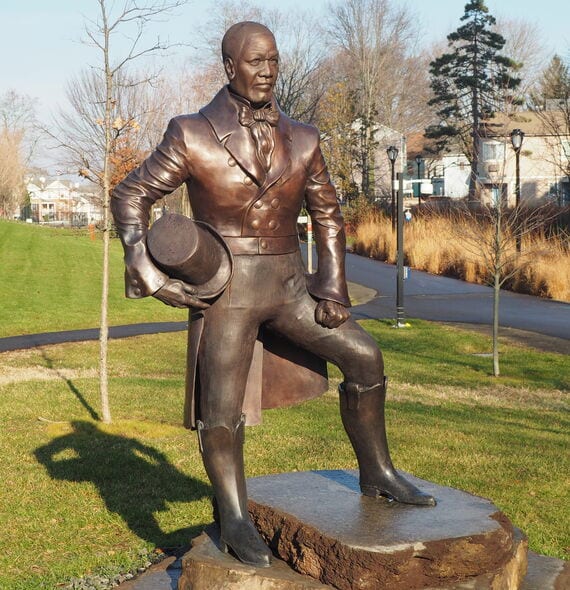
A statue of him was raised on the Farmington Canal Trail in 2020, a hundred and sixty-nine years after he died.
Where this sign stands
The Mill River Trail south of Grand Avenue, looking across to New Liberia
The sign at this spot
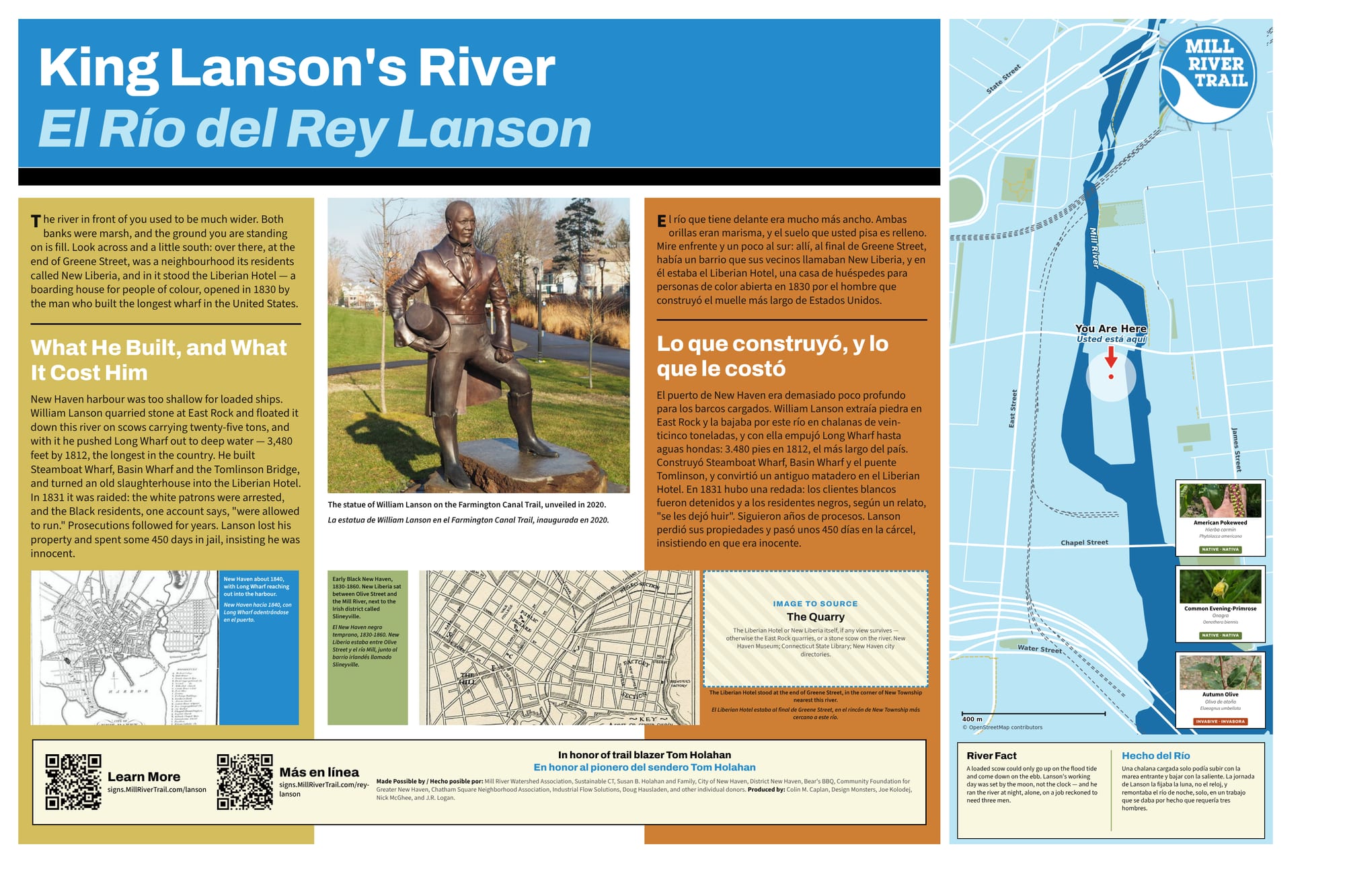
The full sign, in English and Spanish. Zoom in to read it.
This sign is still a draft. The hatched boxes are photographs that have not been sourced yet.
Sources and further reading
Where a link goes to a scanned original — a newspaper page, a map, an engineering journal — it is the actual document, not a summary of it.
- Long Wharf Pier — National Register of Historic Places nomination, 2024 (CT SHPO)
- William Lanson: New Haven's African King — Yale-New Haven Teachers Institute (source of the quotation)
- The successes and struggles of William Lanson — Connecticut History
- William Lanson shaped New Haven — National Endowment for the Humanities
- William Lanson revealed — New Haven Independent
- William Lanson — Wikipedia
Research and credits
Historical research for the Mill River Trail signage was carried out by Colin M. Caplan of Magrisso Forte and John R. Logan, with contributions from Jason Bischoff-Wurstle of the New Haven Museum and walk notes by Steve Hamm. Images are credited individually. Locator maps are drawn from OpenStreetMap, © OpenStreetMap contributors, ODbL.
This page last changed 2026-10-12.