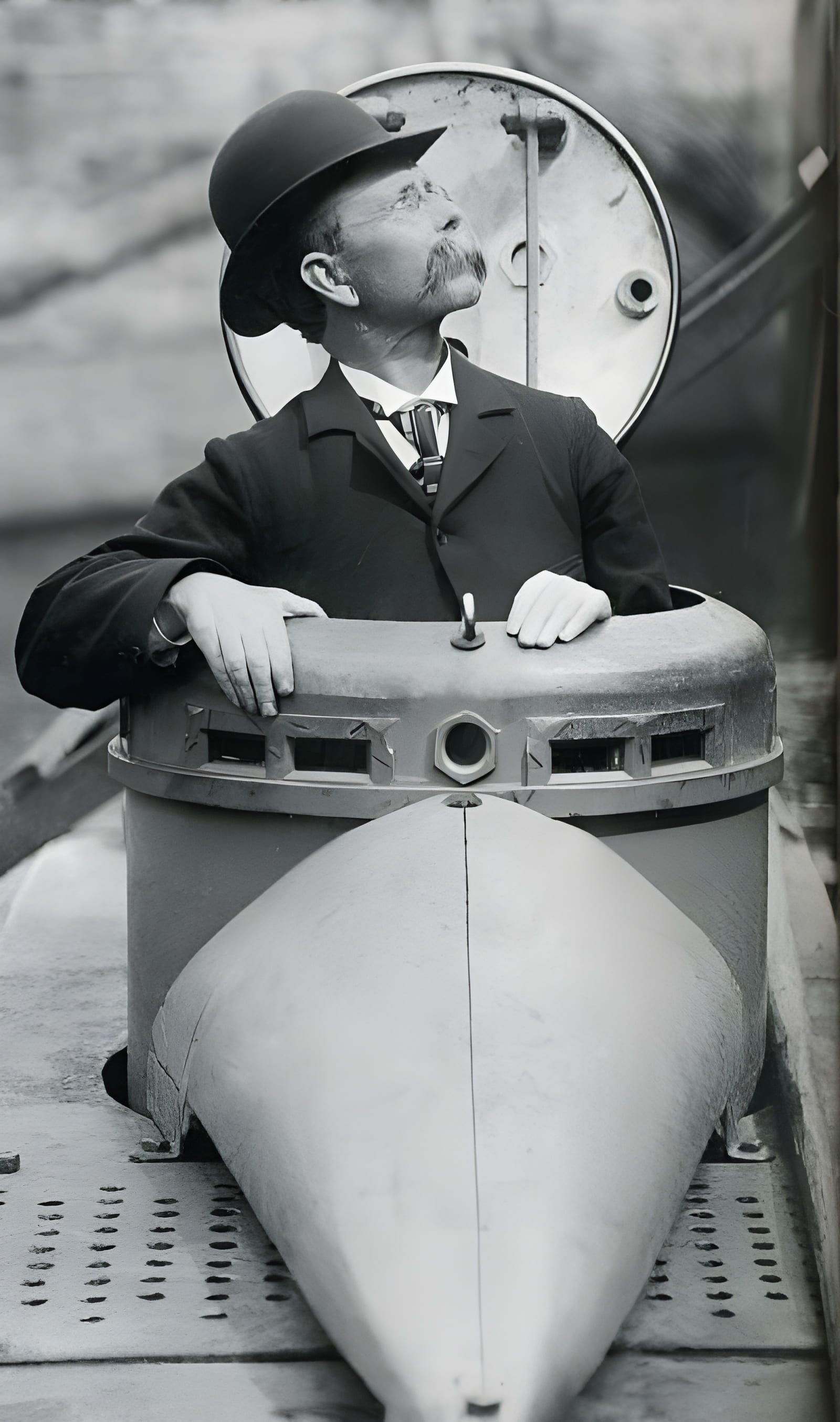
In the late 19th century New Haven became an unlikely home for a revolutionary submarine prototype — a story that ties the city's industrial capacity to Irish-American political activism.
An Irish schoolteacher turned inventor
John Philip Holland was born in County Clare, Ireland, in 1841 and began his working life as a schoolteacher. He emigrated to Boston in 1872, moved to Paterson, New Jersey, and by 1875 was designing submarines. The US Navy had already dismissed his plans as impractical — "a fantastic scheme of a civilian landsman."
The Fenian Brotherhood, the American counterpart to the Irish Republican Brotherhood, saw the possibilities the Navy did not. After Holland successfully tested a 33-inch model at Coney Island, the Brotherhood's Skirmishing Fund put up $4,000 for a full-sized boat, then $20,000 for a second and much larger one.
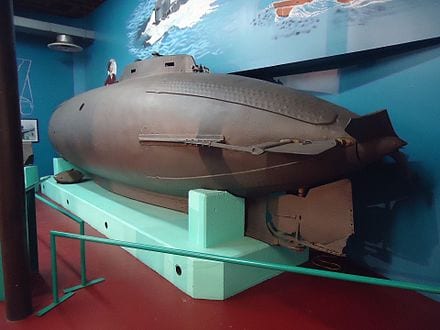
The Fenian Ram
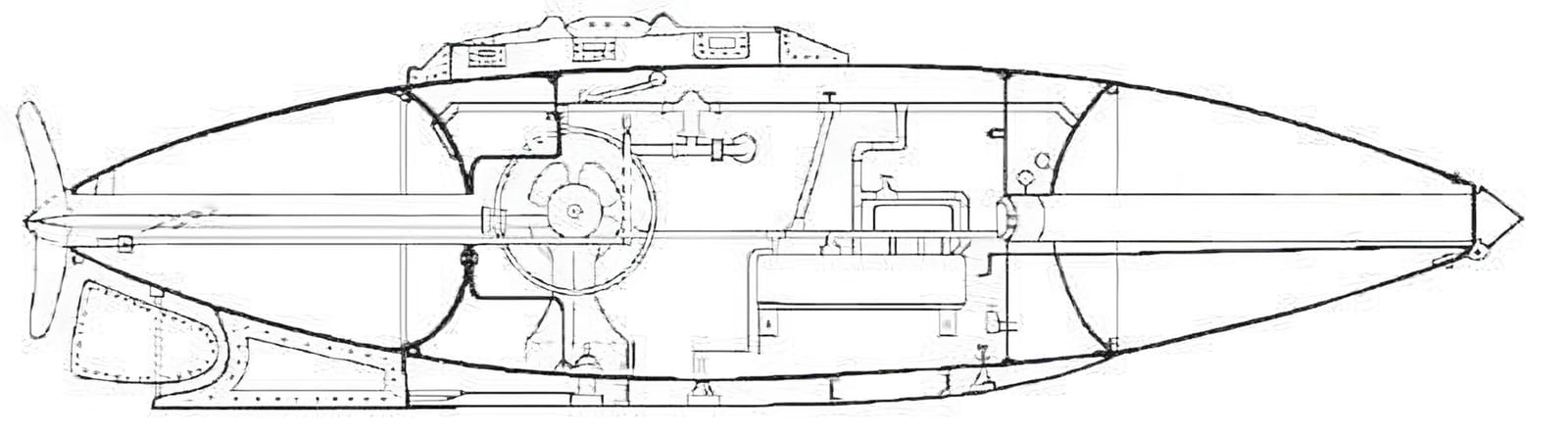
Launched in 1881 from the Delamater Iron Company in New York, Holland Boat No. II was christened the "Fenian Ram" by a reporter at the New York Sun. She was 31 feet long, six feet across, and weighed 19 tons. A three-man crew ran her: a pilot working two upright levers like joysticks, an engineer minding the valves and ballast, and a gunner operating an eleven-foot pneumatic gun that ran through the center of the forward air reservoir.
With the single exception of the periscope, which had not yet been invented, the Fenian Ram contained all the principal engineering ideas of the modern submarine. She dove in excess of 45 feet and successfully test-fired dummy projectiles supplied by the designer of the Monitor. Navigating blind, however, was perilous — in June 1882 she struck a Weehawken ferryboat and sank. Nobody was hurt, and she was raised within the week.
Stolen
In November 1883 a dispute over money erupted between Holland and the Brotherhood. Fearing that pending lawsuits would tie up Fenian property, a group of Fenians used a forged pass carrying Holland's own signature to enter the dock, and towed the Ram and a 16-foot model out of New York Harbor. The smaller boat sank in choppy water on the way. The Ram made it to New Haven.
There the thieves discovered they had no idea how to operate her. Holland refused to help. Attempts to run her in New Haven Harbor went so badly that the harbor master declared the boat a menace to navigation and forbade further trials.
SubmarineForceMuseum.jpg)
Thirty-three years in a shed
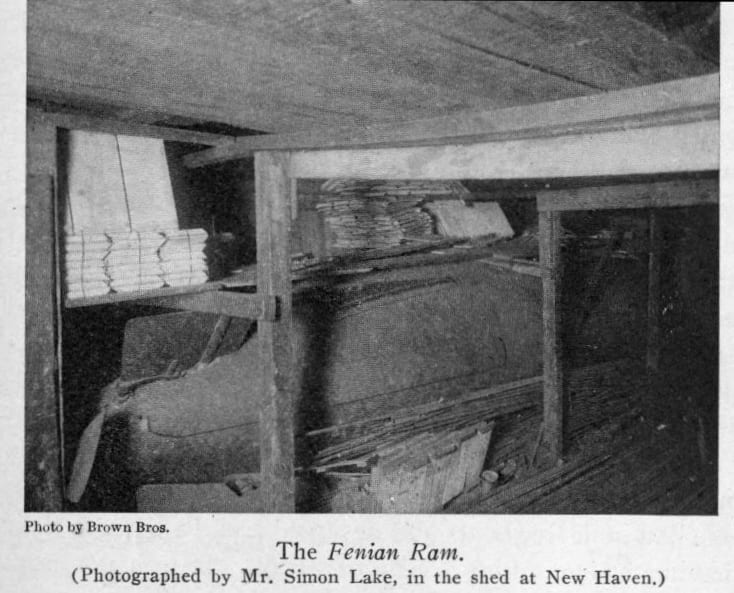
Unable to use or sell the submarine, the Brotherhood had her hauled ashore and put in a lumber shed on the Mill River, said to have been at 99 Mill River Street — across the water from where you are standing. Her 15 horsepower Brayton oil engine was pulled out and set to work driving a forge in James Reynolds' brass foundry. The empty steel shell sat there gathering dust, the curiosity of the whole neighborhood, from 1883 until 1916.
What the New Haven papers said at the time
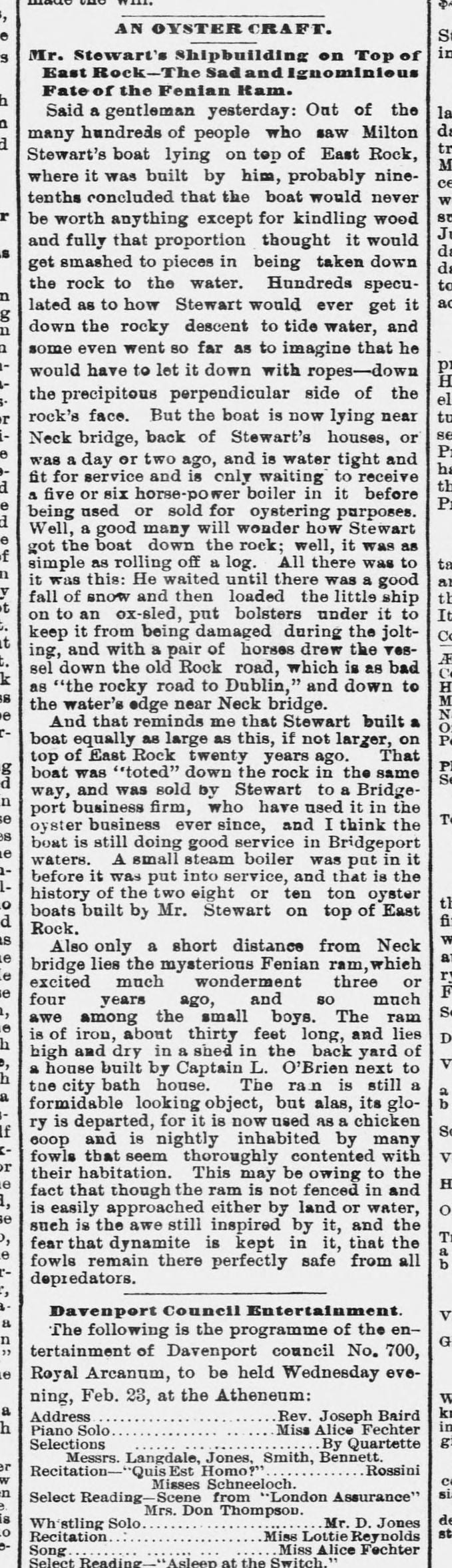
The submarine was not a secret. It was a local curiosity, and the New Haven Morning Journal and Courier mentioned it more than once while it sat there.
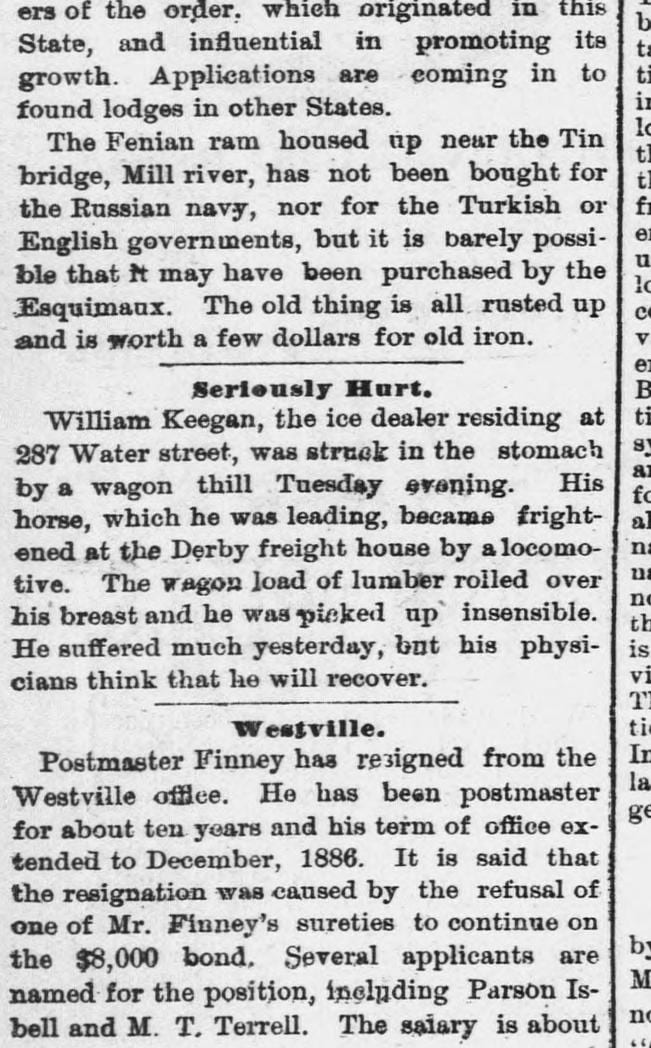
In May 1885, amid rumours that it had been sold to a foreign navy, the paper was dry about it: the Fenian ram "housed up near the Tin bridge, Mill river, has not been bought for the Russian navy, nor for the Turkish or English governments, but it is barely possible that it may have been purchased by the Esquimaux. The old thing is all rusted up and is worth a few dollars for old iron."
In February 1887 it turns up again, at the end of a story about a man who built an oyster boat on top of East Rock and dragged it down on an ox-sled. "Also only a short distance from Neck bridge," the paper adds, "lies the mysterious Fenian ram, which excited much wonderment three or four years ago, and so much awe among the small boys. The ram is of iron, about thirty feet long, and lies high and dry in a shed in the back yard of a house built by Captain L. O'Brien next to the city bath house."
Two things follow from that. The submarine's neighbour was the city bath house — the subject of another sign on this trail. And the boy who stood and stared at it in 1884 was doing roughly what you are doing now.
Where exactly?
The account usually given is that the Ram was stored at 99 Mill River Street, across from the ground the District now occupies. The 1885 and 1887 newspaper items instead put it near the Tin bridge and a short distance from Neck Bridge, which is the old State Street crossing further north.
These may not conflict — it sat there for thirty-three years and could have been moved — but the contemporary reports are the better evidence for where it was in the mid-1880s, and the project has not settled the question.
SubmarineForceMuseum.jpg)
Out of the shed
In 1916 the Fenian Ram was hauled onto a wagon and driven through the streets of New Haven — photographs survive of her passing down Olive Street — on her way to Madison Square Garden, where she was exhibited to raise money for victims of the Easter Rising. She went next to the New York State Marine School. In 1927 Edward Browne bought her and moved her to Paterson, Holland's adopted home, where she remains on display at the Paterson Museum.
Holland went on to win US Navy design competitions in 1888 and 1893. He died in 1914. Within forty days of his death a single submarine off the Dutch coast sank three British cruisers and killed more than 1,400 men. The New York Times noted that "although he was interested in submarines, Mr. Holland was opposed to war, and his idea of submarines was to incapacitate warships and not to destroy them and kill the men on them." In his 1907 sketches he had drawn a 40-passenger submarine with large circular viewing ports, meant "for amusement at seaside resorts."
FenianRam1.jpg)
SubmarineForceMuseum.jpg)
Where this sign stands
Along the District, off Humphrey Street (visible from the Stack)
The sign at this spot
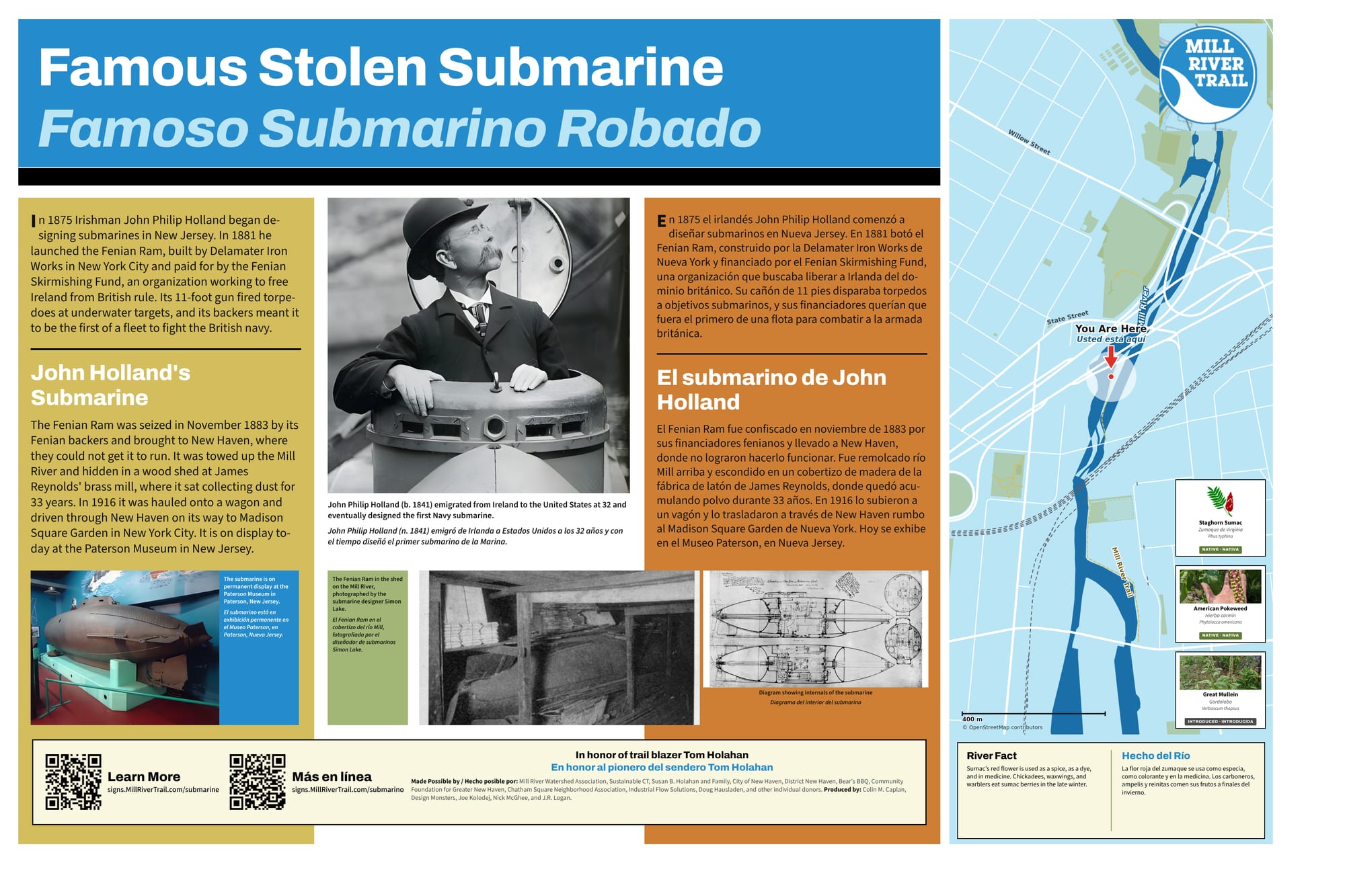
The full sign, in English and Spanish. Zoom in to read it.
Sources and further reading
Where a link goes to a scanned original — a newspaper page, a map, an engineering journal — it is the actual document, not a summary of it.
- Famous Stolen Submarine — Mill River Trail
- Fenian Ram — Historic Naval Ships Association
- Fenian Ram — Wikipedia
- The Fenian Ram — Gas Engine Magazine
- John Philip Holland, Irish inventor of the submarine — IrishCentral
- The Fenian Ram in the New Haven papers, 1885 — Chronicling America
- Paterson's fleet honors sub inventor, 1973 — New York Times
Research and credits
Historical research for the Mill River Trail signage was carried out by Colin M. Caplan of Magrisso Forte and John R. Logan, with contributions from Jason Bischoff-Wurstle of the New Haven Museum and walk notes by Steve Hamm. Images are credited individually. Locator maps are drawn from OpenStreetMap, © OpenStreetMap contributors, ODbL.
This page last changed 2026-10-12.