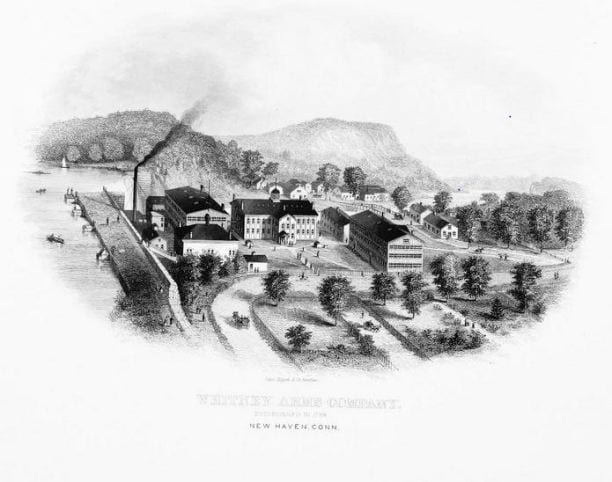
Everything about the Mill River starts here. The river takes its name from the mills built on its banks to use the current, and the first of them — Christopher Todd's gristmill, grinding corn for the colony — stood on this spot from 1642. By 1780 there were eight mills on the river. Farmers rented time at them to grind their grain.
The mill that named the river
Before any of this there was one mill, and it is the reason the water has the name it has.
Around 1640 the New Haven Colony put up a communal, water-powered corn mill at the lower falls, on the ground where the armory and then the dam would later stand. In the colony's records it is not given a name. It is just "the mill" — and the water running past it became the Mill River, which is what everyone has called it for nearly four hundred years.
We also know it was badly built, because somebody was taken to court over it. From the General Court of New Haven in 1642:
Richard Beach for nott performing covenant in the worke w[hi]ch he undertooke to doe att the mill, w[hi]ch he was to doe strongly and substantially, butt did itt weakely and sleightly as was proved by the testimony of John Wakefield the miller, himselfe allso nott denying itt; Itt was ordered that he should make good the damage, butt because the damage is not justly known what itt is, Mr. Goodyeare and Mr. Gregson are to [v]eiw the worke, and consider off and sett downe the damage by his [defec]tive workmanship.
A contractor who cut corners, a miller who testified against him, a contractor who did not even bother to deny it, and two men sent out to price the damage. That is the earliest human voice we have from this spot, and it is a building dispute.
1798
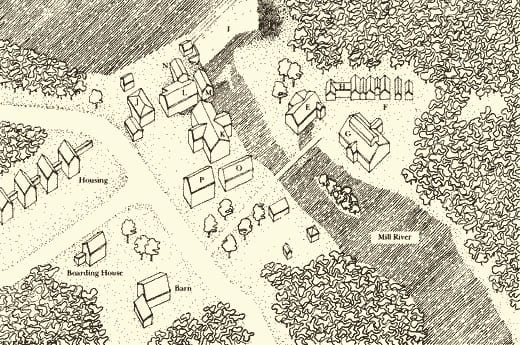
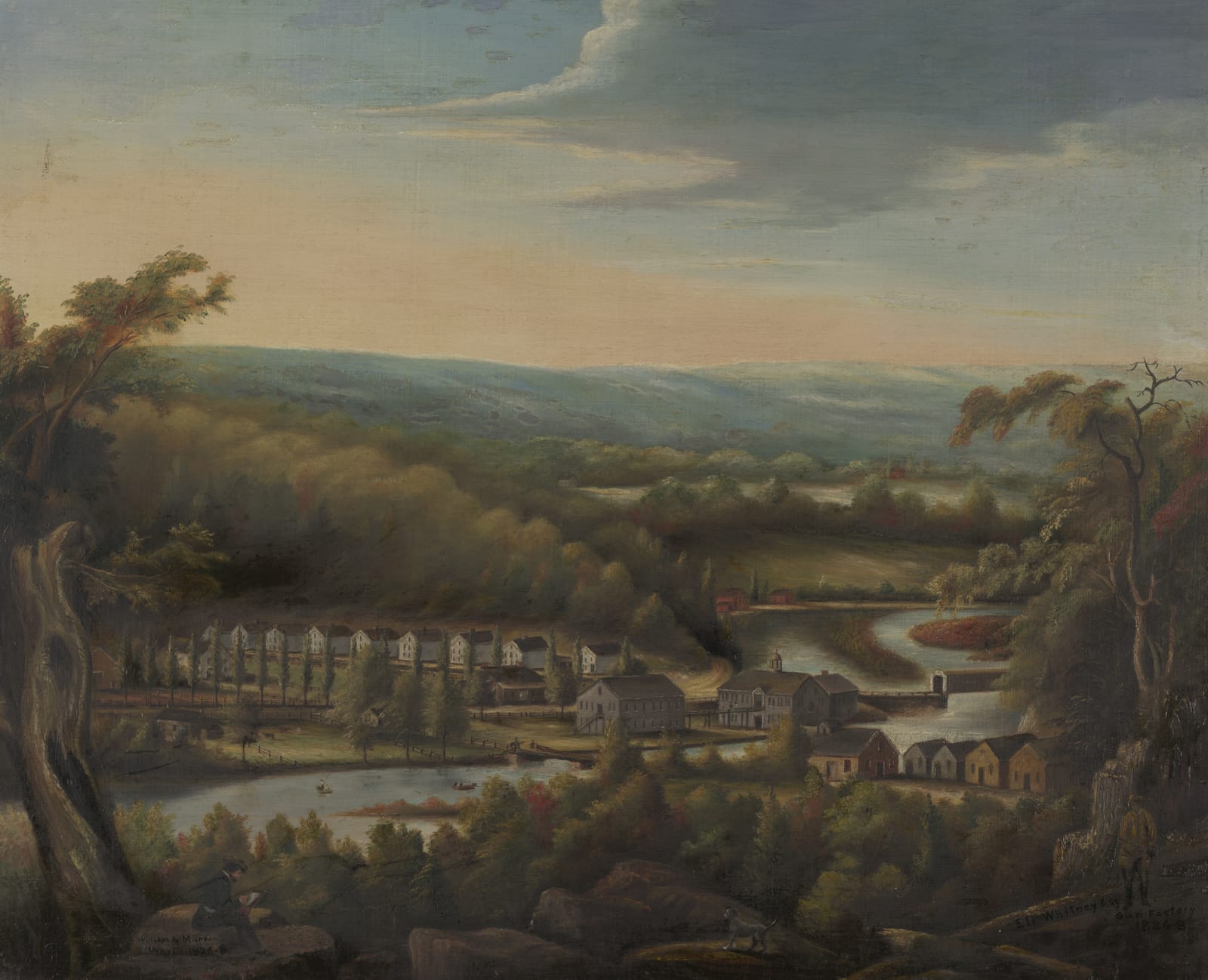
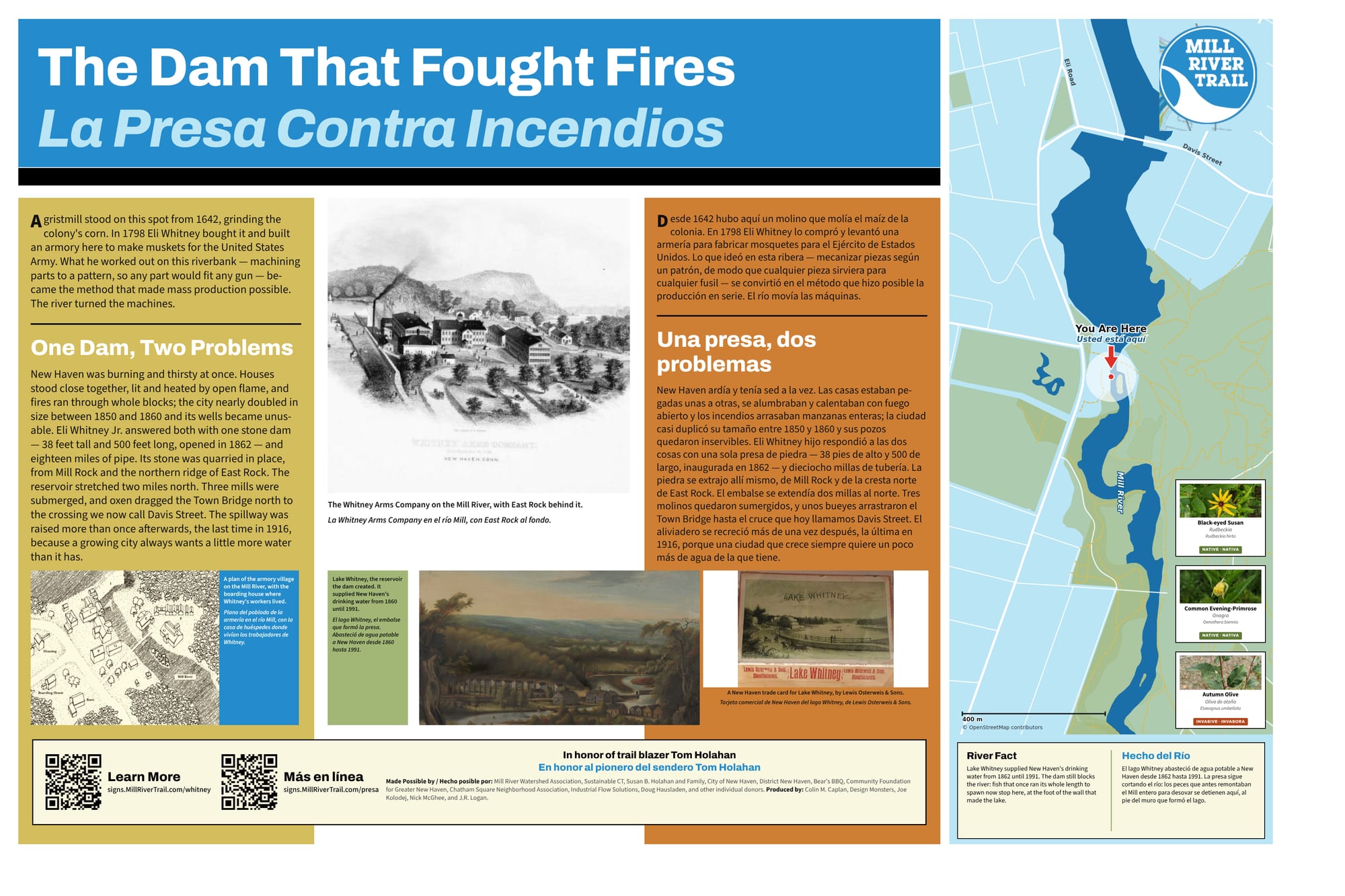
In 1798 Eli Whitney bought Todd's mill and the ground around it, and built an armory.
Whitney is remembered for the cotton gin, which he patented in 1794 and made almost nothing from, because it was too easy to copy. The armory was the second act. He took a contract to supply muskets to the United States Army — a large order, on a short deadline, with no workforce of trained gunsmiths to draw on.
His answer was to change what a worker had to be able to do. Instead of one craftsman filing a whole gun to fit itself, machines guided by jigs and patterns would cut each part close enough to a standard that any part would fit any gun. The skill moved out of the hand and into the machine.
Whitney did not invent the idea, and historians have spent a long time arguing about how completely his own muskets achieved it. But the method that came out of this riverbank — interchangeable parts, machine tools, division of labour — is the one that made American mass production possible. The water turned the machinery.
The fires
By the middle of the 19th century New Haven had a serious fire problem. The population was growing, houses stood close together, and light and heat came from oil lamps and open flames. Fires started often and ran through whole blocks.
The water to fight them came from the Mill River and from the Farmington Canal. When the canal was drained and converted into a railway, that second source disappeared, and the city was left short.
Eli Whitney Jr. — the inventor's son, running the family works upstream in Whitneyville — led the effort to found the New Haven Water Company and to dam the river properly. He had his own reason as well: a higher dam meant more head, and more head meant more power for his mills.
The dam
The original dam was wooden. Whitney and his son rebuilt it in masonry and raised it repeatedly: from roughly six feet to about twenty-seven in 1860, to thirty-one in 1866, and by another nineteen inches in 1916, which is close to its height today.
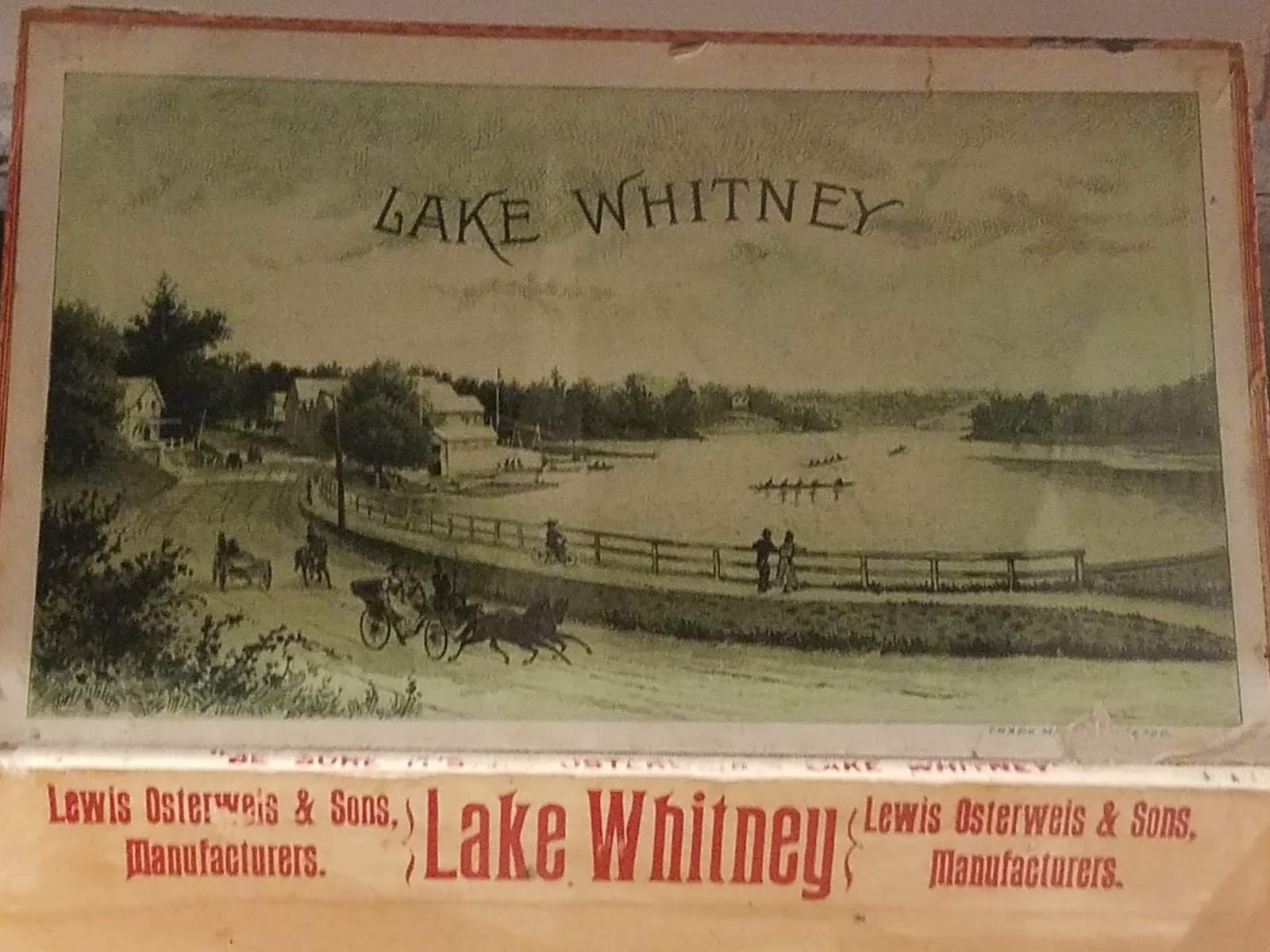
The reservoir it created was named Lake Whitney, and for about a hundred and thirty years it was a major part of the public water supply for New Haven County. It served in that role until 1991. The upper Mill River is still strictly regulated because of it — industry was removed from the river above the reservoir, and the water quality upstream has stayed good.
What a dam costs
A dam is a wall across a migration route. River herring — alewives and blueback herring — spend their lives at sea and return to fresh water each spring to spawn, and before 1860 they could run the length of the Mill River. After 1860 they could run as far as this wall.
That is the trade the city made, and it is one the region has been slowly revisiting: fish passage, fishways and dam removals across Connecticut have been reopening rivers to the spring run.
Come back in April
There is one more thing this dam does, and you can watch it happen.
River herring — alewives first, from late March, then blueback herring from May — come in from the sea every spring to spawn in fresh water, returning to the river they hatched in. They come up the Mill River, past the tide gates, through the city.
And then they stop. Here. There is no fish ladder on this dam. The alewives gather in the plunge pool at the foot of the spillway, in the shallow water behind the museum, and that is as far up their own river as they can get. Everything above you — Lake Whitney and roughly fourteen miles of watershed beyond it — has been closed to them since 1860.
The birds know. Cormorants, great blue herons, black-crowned night-herons and ospreys collect below the dam in spring for exactly this reason.
You may not take them. River herring are under a statewide closure in Connecticut, in fresh and salt water alike, because the coastwide population collapsed. Watching is the whole of what is permitted, and it is worth the walk.
The site today
The armory site is now the Eli Whitney Museum, and the barn, the dam and the water works are the most legible industrial landscape on the river. Downstream from here the Mill River becomes something else entirely — tidal, filled, bridged, and built over — but this is where it began.
The sign at this spot
The full sign, in English and Spanish. Zoom in to read it.
Sources and further reading
Where a link goes to a scanned original — a newspaper page, a map, an engineering journal — it is the actual document, not a summary of it.
- Connecticut anadromous fish runs — CT DEEP
- Records of the Colony and Plantation of New Haven, 1638-1649, ed. Hoadly — the 1642 mill case
- Lake Whitney Dam — Historic American Engineering Record, HAER CT-186-C (Library of Congress)
- The Eli Whitney Museum — historic site
- The Eli Whitney Museum — arms production
- The Whitney Armory helps progress in Hamden — Connecticut History
- 1888 map showing the Whitney site — Library of Congress
- Christopher Todd's mill — Centenary of Hamden, Connecticut, 1886
- Mill River history — Mill River Trail
Research and credits
Historical research for the Mill River Trail signage was carried out by Colin M. Caplan of Magrisso Forte and John R. Logan, with contributions from Jason Bischoff-Wurstle of the New Haven Museum and walk notes by Steve Hamm. Images are credited individually. Locator maps are drawn from OpenStreetMap, © OpenStreetMap contributors, ODbL.
This page last changed 2026-10-12.